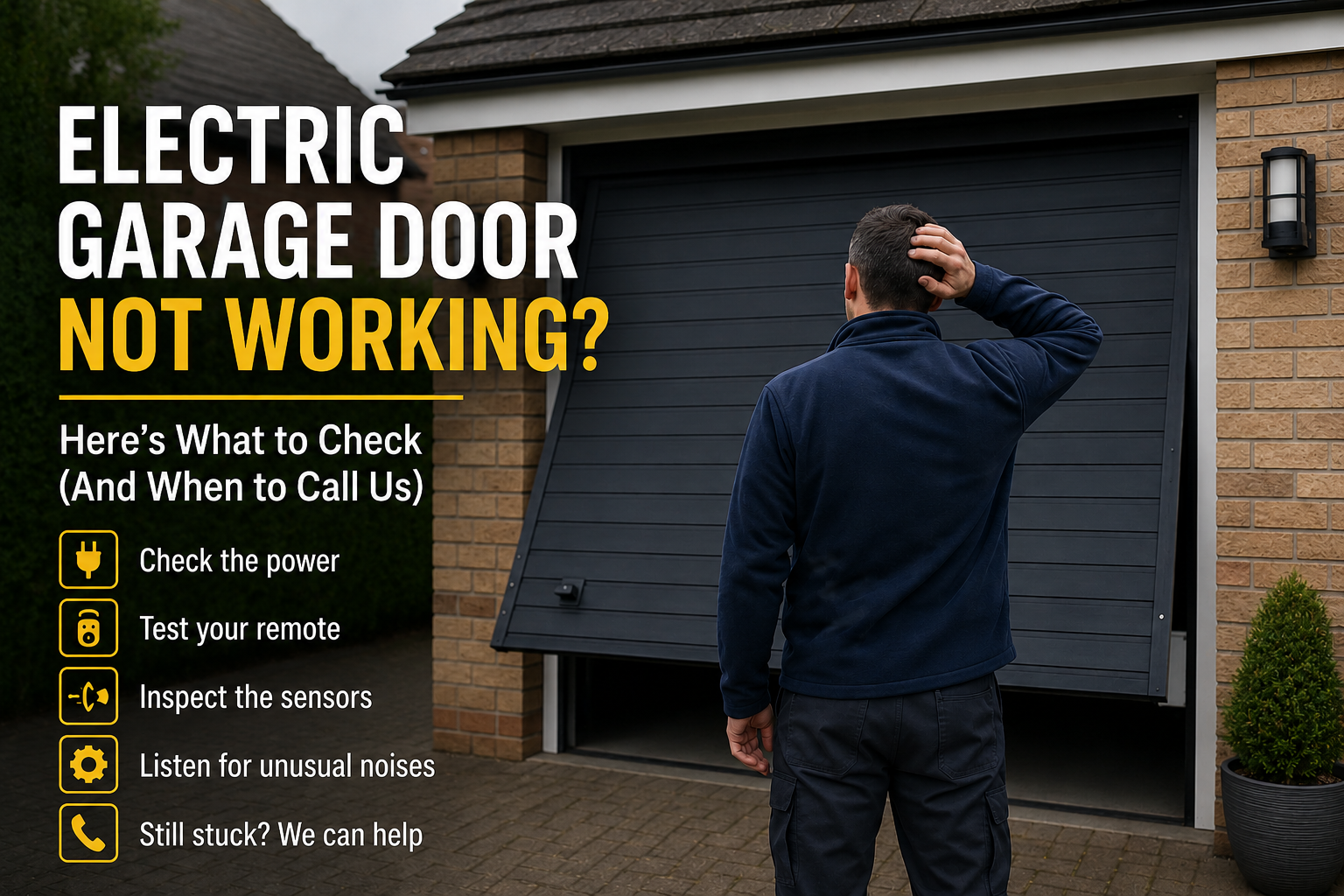
Your electric garage door has stopped working. Maybe it's stuck halfway, making a grinding noise, or not responding to the remote at all. Whatever's happened, it's frustrating — especially if the car's stuck inside or you're running late.
This guide walks you through the most common causes and what you can do about each one. We'll be straight with you: some of these you can sort yourself in two minutes. Others need a trained engineer — and trying to fix them without the right knowledge can be dangerous or make things worse.
1. Check the Obvious Stuff First
Before anything else, run through this quick checklist:
- Is it plugged in? The motor unit plugs into a standard mains socket. Check it hasn't been knocked out — and that the socket itself is working (plug something else in to test it).
- Has the circuit breaker tripped? Head to your consumer unit and look for any switches that are in the off position or in a middle "tripped" state. Reset them and try the door again.
- Is the remote battery dead? Try the wall-mounted button inside the garage. If that works but the remote doesn't, you just need a new battery.
- Is the door locked? Many doors have a manual lock that disengages the motor drive. Check there's no lock handle or slide bolt engaged.
If none of that fixes it, read on.
2. The Remote or Keypad Isn't Working
What you'll notice: The wall button works fine, but the remote or keypad does nothing.
Likely causes:
- Dead battery in the remote (most common)
- Remote has lost its pairing with the motor unit
- Interference from a nearby device or new LED bulb in the motor unit
What you can try: Replace the battery first. If it's still not responding, most remotes can be re-paired by holding the "learn" button on the motor unit and pressing the remote button — check your manual for the exact steps.
When to call us: If re-pairing doesn't work, or you've lost the remote entirely and need a replacement programmed to your specific motor, give us a ring — we carry compatible remotes for most major brands and can programme them on the spot.
3. The Door Starts Moving Then Stops
What you'll notice: The door opens or closes a few inches, then reverses or stops completely.
Likely causes:
- The motor's travel limits are set incorrectly
- The safety sensors are misaligned or dirty
- Something is physically obstructing the door's path
- A broken or overly-stretched spring is putting too much load on the motor
What you can try: Check the photo-eye sensors at the bottom of the door frame — they're the small units (usually with a red or green light) on either side. If one light is flashing or off entirely, the beam is broken. Clear any debris, wipe the lenses, and make sure they're pointing directly at each other. A small nudge to realign them often solves it.
Also check the floor and tracks for any obvious obstruction.
When to call us: If sensors are aligned, the path is clear, and it's still stopping short — don't keep forcing it. A limit or torque setting adjustment needs to be done carefully to avoid damaging the motor or the door. And if a spring is the issue, please don't attempt to adjust or replace it yourself. Garage door springs are under enormous tension and are one of the most common causes of serious injury in DIY repairs.
4. The Motor Runs But the Door Doesn't Move
What you'll notice: You hear the motor humming or running, but the door stays put.
Likely causes:
- The manual release cord has been pulled (disconnecting the door from the drive)
- The drive trolley or carriage has broken
- The drive belt, chain, or screw has snapped or come off
What you can try: Look at the motor unit on the ceiling — there's usually a red cord hanging from it. If this has been pulled (perhaps during a power cut, so someone could open the door manually), you need to re-engage it. With the door closed, pull the cord back towards the motor unit until you hear a click.
When to call us: If re-engaging doesn't work, or you can see the belt/chain is visibly snapped or hanging loose, this is a job for us. A broken drive mechanism means the door has no support — it could come down suddenly.
5. The Door is Making Unusual Noises
Grinding, scraping, banging, or popping — none of these are normal, and none should be ignored.
| Sound | Likely cause |
|---|---|
| Grinding | Worn or dry gear cogs in the motor |
| Scraping | Door panels or rollers catching on the tracks |
| Popping/cracking | Spring under stress |
| Banging | Loose hardware or a panel out of alignment |
What you can try: Visually inspect the tracks for obvious bends or debris. If the rollers look dry, some people apply a silicone spray lubricant — but avoid WD-40, which attracts dirt and can damage rubber seals.
When to call us: Any noise coming from the springs, or grinding from inside the motor unit, means something is wearing out. Carrying on regardless risks a full failure — usually at the worst possible moment.
6. The Door Won't Close Fully (Leaves a Gap)
What you'll notice: The door closes most of the way but leaves a gap at the bottom, or stops just short of the floor.
Likely causes:
- Travel limit set too short
- Floor seal worn and catching
- Warped panel or bent track
What you can try: Check the floor seal along the bottom of the door — if it's torn, hardened, or bunched up, it might be triggering the safety reverse. A new floor seal is a relatively low-cost fix.
When to call us: Travel limit adjustments and track repairs are best left to us. Getting limits wrong can cause the door to over-travel and damage the panels or motor.
7. Complete Power Failure to the Unit
What you'll notice: No lights, no sounds, nothing at all from the motor.
Likely causes:
- No mains power (socket, fuse, or circuit breaker issue)
- Internal fuse in the motor unit has blown
- Motor has failed
What you can try: Test the socket, check the consumer unit, and if there's a fuse holder on the motor unit itself, check whether the fuse has blown (you'll need a replacement of the same rating).
When to call us: If power is confirmed and it's still completely dead, the control board or motor has likely failed. At that point, repair vs. replacement is the conversation to have — and we can give you an honest assessment.
So When Should You Just Call a Professional?
Here's the honest answer: most electric garage door faults are quicker, safer, and often cheaper to get fixed properly first time rather than after a DIY attempt has made things worse.
You should call us straight away if:
- The door has come off its tracks
- You can see or hear a broken spring
- The door is stuck in the open position (security risk)
- You've tried the basics and it's still not working
- The motor unit has completely stopped responding
- The door is moving unevenly or feels "heavy"
A garage door that's partially working is often one step away from not working at all — or worse, coming down unexpectedly.
We Can Usually Be With You the Same Day
We carry parts for most of the major brands on the van — so in many cases we can diagnose and fix the problem in a single visit.
Book a visit → — takes less than a minute, and we'll confirm a time slot that works for you.
Or if you'd rather speak to someone first: 0330 229 6097